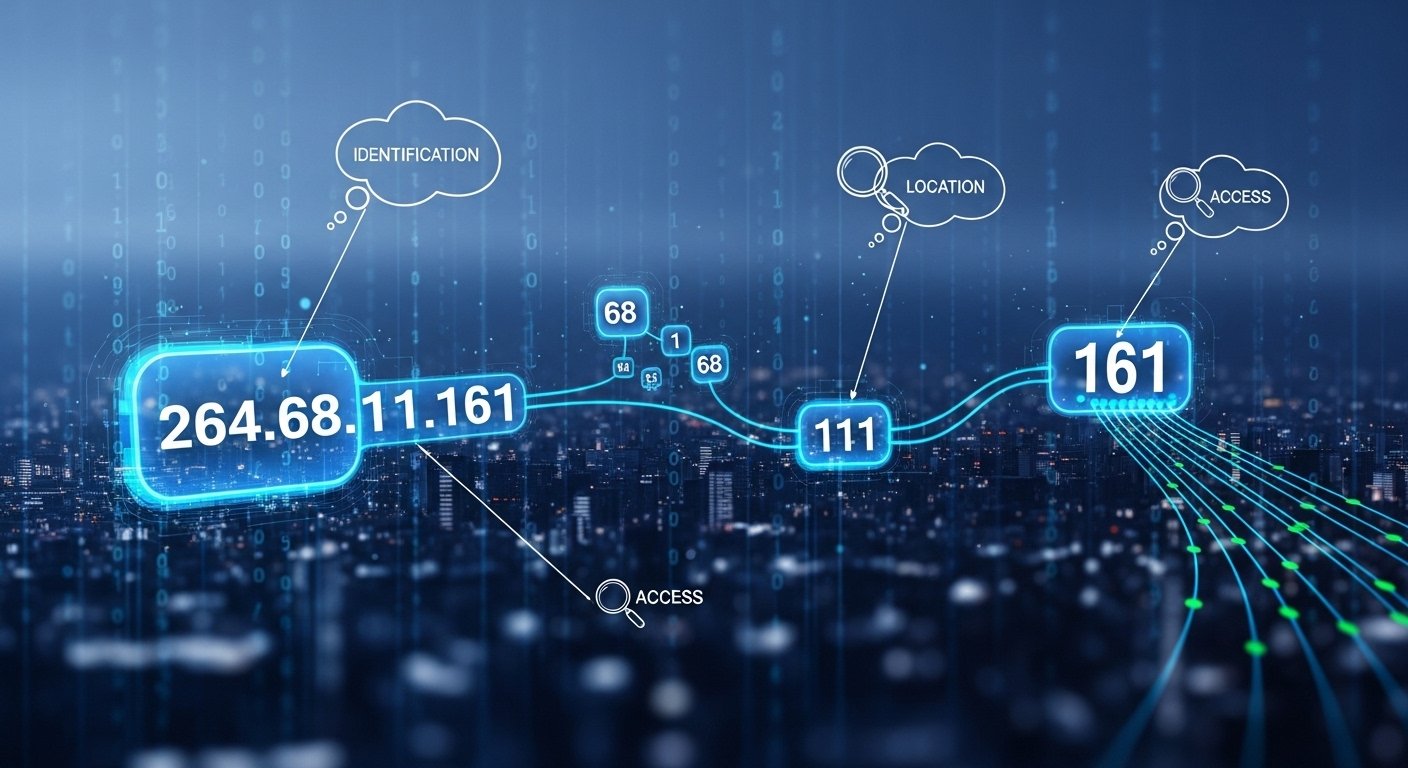
In the digital world, numbers often tell powerful stories. One such example is 264.68.111.161, a sequence that appears to represent an IP address at first glance. IP addresses are the backbone of internet communication, helping devices connect, exchange data, and identify each other across global networks. But when you examine 264.68.111.161 closely, interesting technical details emerge that are worth exploring.
This article breaks down what 264.68.111.161 represents, how IP addresses function, whether this specific format is valid, and why understanding it is essential for website owners, cybersecurity professionals, and everyday internet users.
What Is an IP Address?
An Internet Protocol (IP) address is a numerical label assigned to devices connected to a network. It serves two main purposes: identifying the host or network interface and providing the location of that device within a network.
Most commonly, users encounter IPv4 addresses. These consist of four numbers separated by dots. Each number ranges from 0 to 255. For example, a valid IPv4 address might look like 192.168.1.1.
When looking at 264.68.111.161, it follows the structural format of an IPv4 address: four numeric octets separated by periods. However, structure alone does not determine validity. The actual numerical range of each segment matters greatly.
Is 264.68.111.161 a Valid IPv4 Address?
At first glance, 264.68.111.161 looks legitimate. It follows the familiar pattern. But there’s a technical limitation: in IPv4 addressing, each octet must be between 0 and 255.
The first octet in 264.68.111.161 is 264, which exceeds the maximum allowable value of 255. Because of this, 264.68.111.161 cannot function as a valid IPv4 address.
This makes it an invalid IP address from a networking standpoint. Any system attempting to route traffic to 264.68.111.161 would reject it due to the out-of-range value.
Why Do Invalid IP Addresses Appear?
There are several reasons why something like 264.68.111.161 might appear in logs, software, or documentation:
1. Typographical Errors
Someone may have intended to write a different number but mistakenly typed 264 instead of a valid value like 246 or 204.
2. Placeholder or Test Data
Developers sometimes use non-functional values such as 264.68.111.161 in examples or test environments to prevent accidental live connections.
3. Malformed Data
In cybersecurity investigations, strange entries like 264.68.111.161 can appear in attack logs. These may be generated intentionally to test system validation mechanisms.
4. Data Corruption
Occasionally, logging systems or exported files may contain corrupted entries, turning otherwise valid IP addresses into invalid ones like 264.68.111.161.
Understanding why such anomalies appear can help administrators troubleshoot more effectively.
The Importance of IP Validation
Proper IP validation is essential in web development and cybersecurity. If systems fail to verify input, they may accept invalid data like 264.68.111.161, leading to:
- Broken analytics reports
- Failed API calls
- Security vulnerabilities
- Incorrect firewall configurations
Developers use validation rules to ensure each octet remains between 0 and 255. This prevents errors caused by entries such as 264.68.111.161.
For instance, form validation scripts often check whether a number exceeds 255 before accepting it as part of an IP address.
Could 264.68.111.161 Exist in IPv6?
IPv6 addresses use a completely different format. Instead of four decimal numbers, they use eight groups of hexadecimal values separated by colons.
Because of this, 264.68.111.161 does not qualify as a valid IPv6 address either. It simply does not meet the structural requirements.
This confirms that 264.68.111.161 has no valid standing in either IPv4 or IPv6 networking systems.
How Networking Systems Handle Invalid IPs
Modern systems are designed to reject invalid addresses quickly. If 264.68.111.161 were entered into:
- A browser’s address bar
- A server configuration file
- A firewall rule
- A DNS setting
The system would typically display an error or refuse to process the request.
This built-in validation prevents routing confusion and maintains the integrity of internet communication.
Cybersecurity Perspective on 264.68.111.161
From a cybersecurity standpoint, strange addresses like 264.68.111.161 can serve as warning signs. Attackers sometimes inject malformed data into logs to:
- Test system weaknesses
- Trigger parsing errors
- Evade detection mechanisms
Security teams reviewing logs should not automatically dismiss entries like 264.68.111.161. Instead, they should investigate whether the appearance signals attempted manipulation.
Even though 264.68.111.161 is technically invalid, its presence in logs may carry diagnostic importance.
Lessons for Website Owners and Developers
If you manage websites, servers, or applications, understanding invalid addresses such as 264.68.111.161 is valuable. Here are practical steps you can take:
- Implement strict input validation.
- Sanitize all user-submitted data.
- Monitor logs for malformed IP entries.
- Use reliable networking libraries instead of custom validation logic.
These steps reduce risks and ensure your systems remain stable and secure.
Why People Search for 264.68.111.161
Search queries for 264.68.111.161 often come from:
- Users checking suspicious activity
- Developers debugging applications
- Security analysts reviewing logs
- Students learning networking fundamentals
The curiosity usually arises because the address looks legitimate but behaves unexpectedly. That contrast makes 264.68.111.161 an educational example of how strict technical standards govern internet infrastructure.
Conclusion
Although 264.68.111.161 appears to resemble a standard IPv4 address, it fails validation because its first octet exceeds the allowable range of 0 to 255. As a result, 264.68.111.161 is not a valid IP address in practical networking.
However, its appearance in logs, systems, or documentation can still hold meaning. It may signal typos, testing data, corrupted entries, or potential security probing. Understanding why 264.68.111.161 is invalid—and how systems respond to such entries—strengthens your grasp of networking fundamentals.
In the end, even invalid numbers can teach important lessons about how the internet truly works.